BorrowerCheck™
Point Predictive's proprietary AI screens for fraud across five checks.
- Fraud Alert
- Synthetic ID
- OFAC
- Red Flags
- Military Lending Act
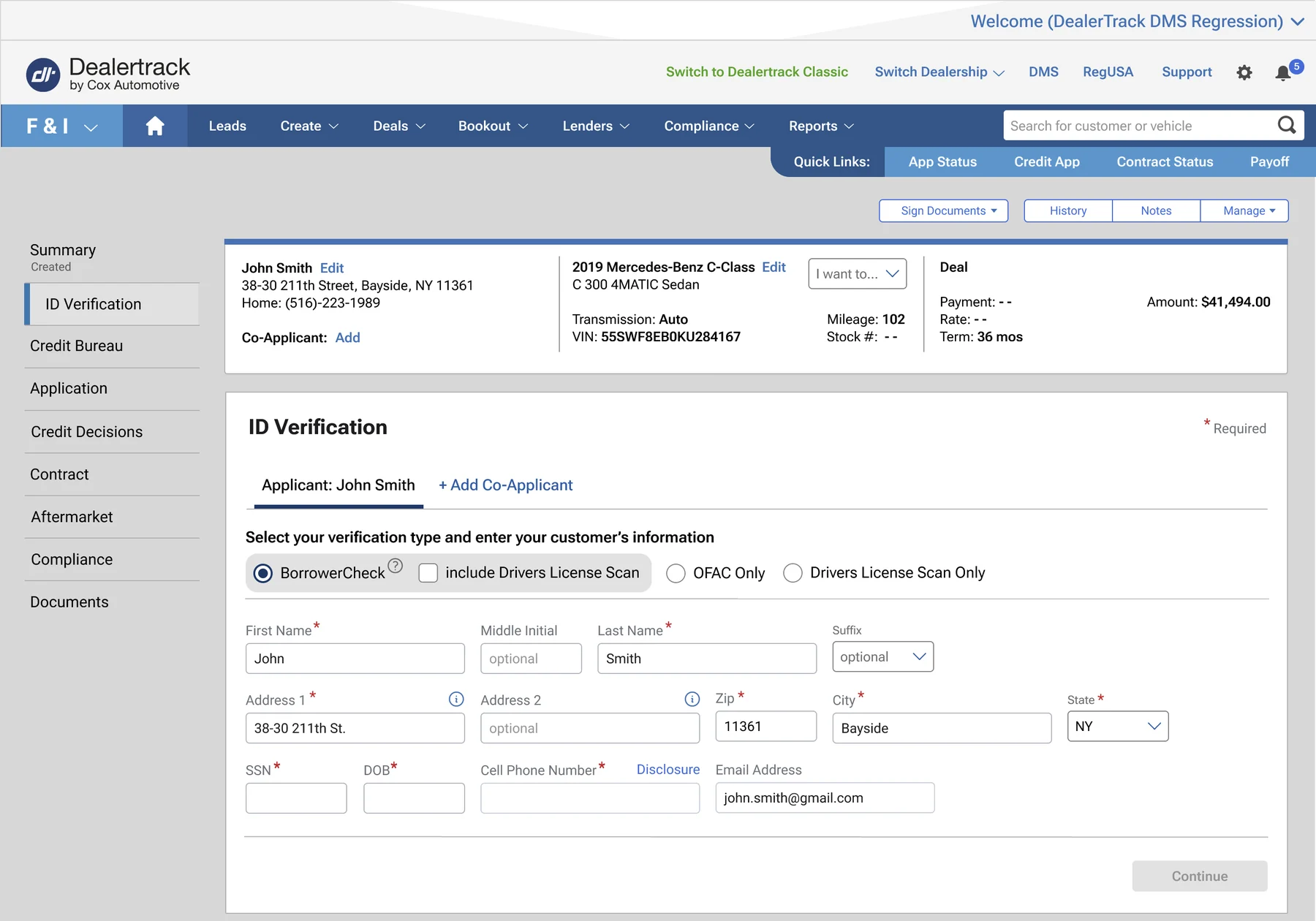
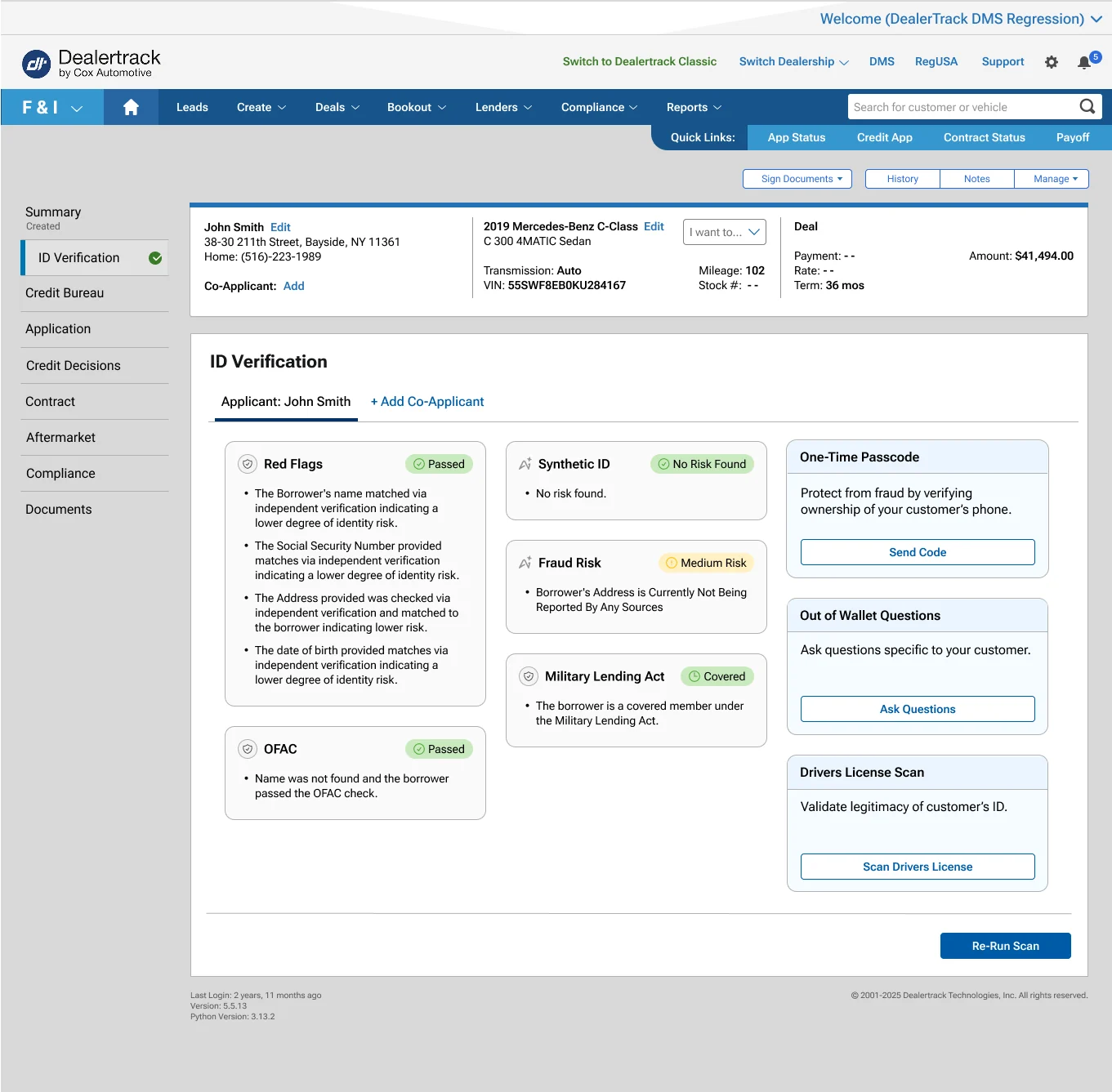
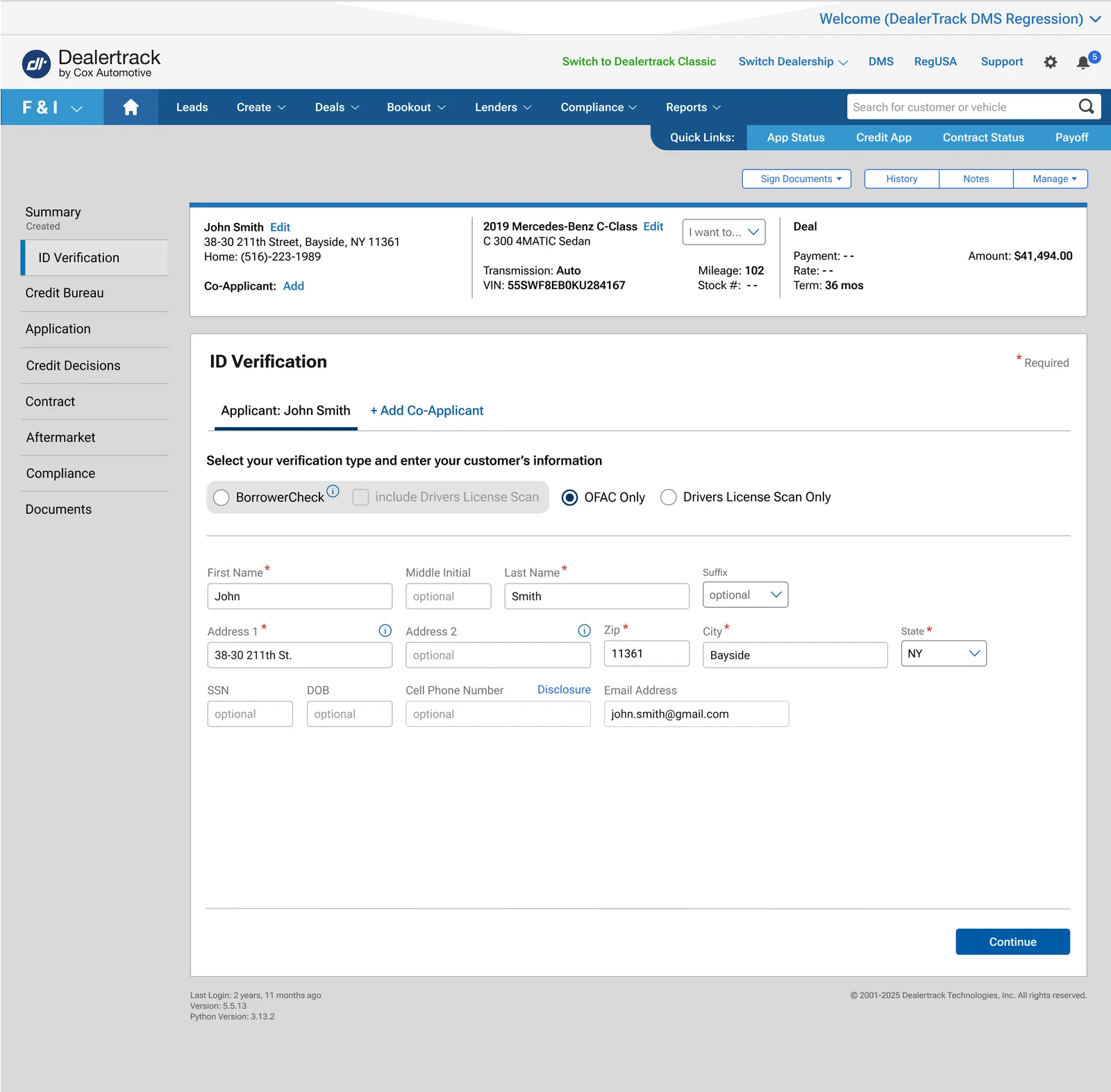
I Integrated an AI-powered third-party fraud analytics solution into the existing F&I compliance workflow, where deal accuracy, compliance, and speed all carry real weight. The goal: make fraud detection feel native to the dealer’s workflow, not bolted on.
Learn MoreF&I managers were navigating compliance checks manually: a fragmented, time-consuming process that created friction at a critical point in the deal.
Without real-time fraud signals in context, dealers made decisions with incomplete information, and compliance stayed reactive. There was no prior UX research on these workflows, and significant technical constraints to design around.
Point Predictive's proprietary AI screens for fraud across five checks.
Identity verification sent to the customer's phone, returning one of three results.
A 6-digit code the customer enters within a time limit to confirm they control the phone on file.
Minimize friction, maximize trust and efficiency.
Real-time signals that reduce reliance on manual compliance checks and improve decision confidence.
One step sends the license scan and selfie capture to the customer's phone, with status tracked inside the deal.
Intelligent alerts and verification outcomes that guide dealers toward safer, faster deal closings.
Adapts to evolving mandates and future additions like auto-filled deal jackets and multi-verification flows.
Mapped pain points across the existing F&I workflow to set a baseline.
Studied how RouteOne approaches identity verification and fraud checks.
Repositioned fraud detection as a natural step in the deal, not an interruption.
Clickable prototypes tested with F&I managers on states, verification, and alerts.
Custom components and a modular widget framework, built for the MVP and ready to scale.
The heuristic audit showed compliance was a manual detour. Each finding shaped a design decision.
Dealers pieced verification together outside the deal flow.
Solution: Fraud checks embedded in the credit application.
Dealers made decisions with incomplete information.
Solution: Real-time result cards on the ID Verification screen.
Problems surfaced after the fact, not when they could be acted on.
Solution: Result cards paired with step-up tools that point to the next action.
Dealers had to parse jargon under time pressure.
Solution: Color-and-label status pills with plain-language reasons.
Dealers opt into fraud checks inside the Credit Bureau Application they already complete on every deal. Then one validation, one submit, and the bureau request processes. For deeper checks, including the driver's license scan, dealers use the dedicated ID Verification step.
All bureaus, or Equifax, Experian, and TransUnion individually
Synthetic ID and Red Flags / OFAC checks, opted in with a checkbox
Personal, address, identification, and contact details
Confirm permissible purpose, or capture the customer's signature
Five paths, one verification results screen. Pick a path to walk through it.
Re-run available
Re-run available
Resend available
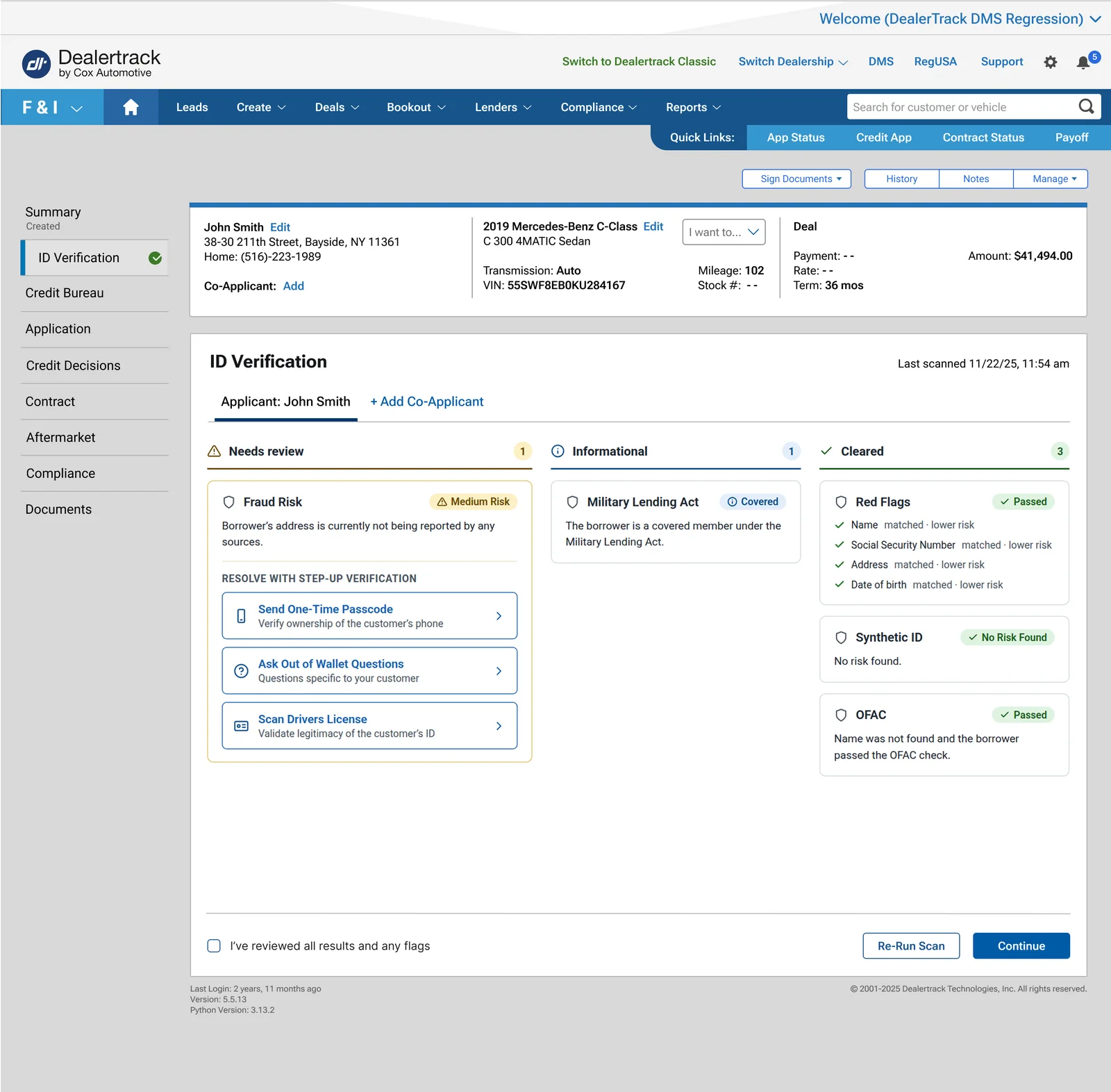
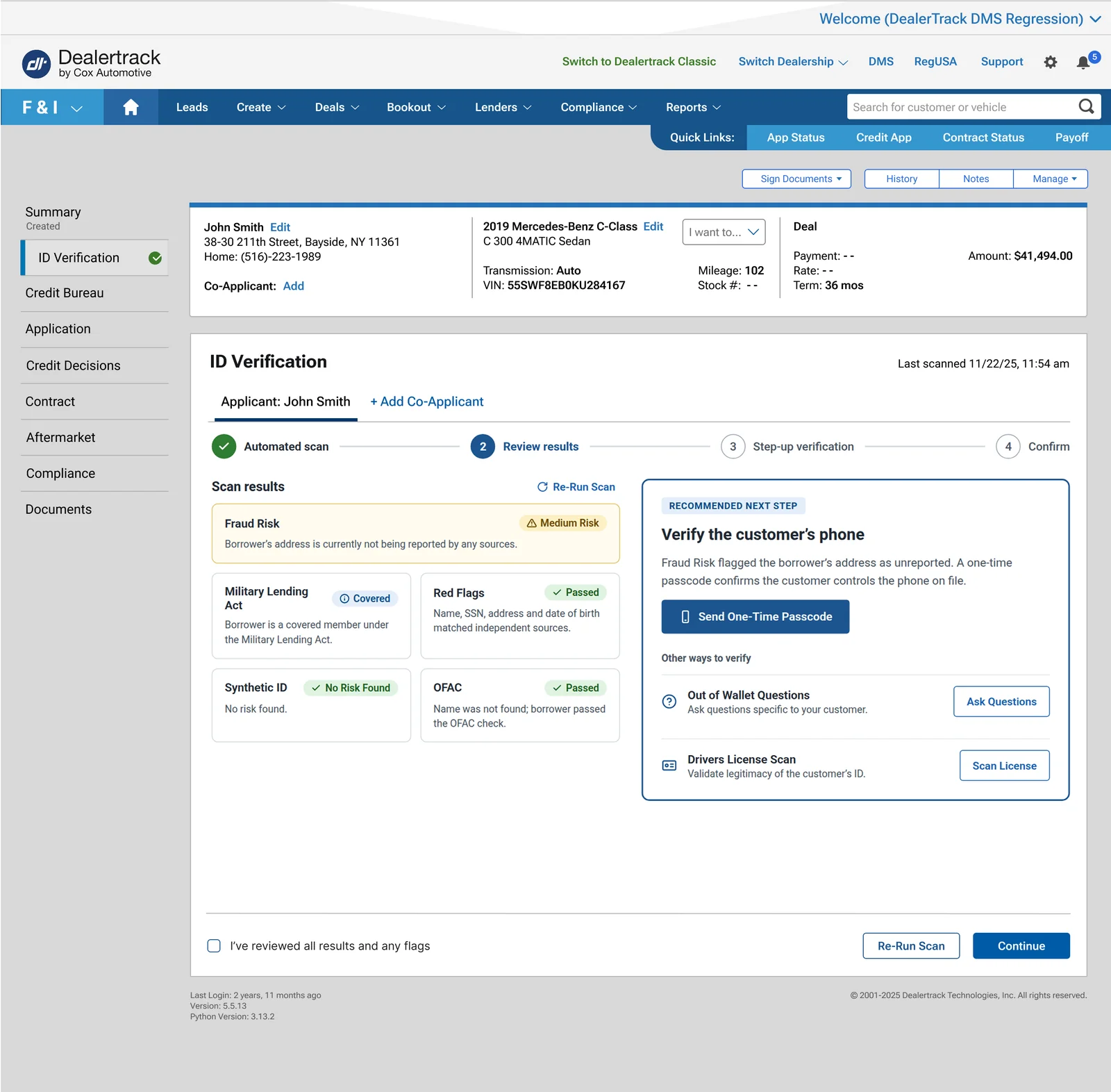
Results guide the dealer to the next action. Each automated check gets its own card with a status pill. Cards appear only when relevant, and optional step-up tools sit in their own column beside them.
Automated checks
Step-up verification
Scan Drivers License Send One-Time Passcode Ask Out-of-Wallet QuestionsOne verification screen that flexes to every subscription tier, with the license scan as an opt-in add-on to BorrowerCheck™.
Distinct UI states with clear hierarchy, so dealers orient at a glance instead of parsing compliance language under pressure.
Send the scan to the customer's phone in one step, then track verified, not verified, or pending status inside the deal.
Fraud signals framed as decision support. Messaging is directive without being alarmist.
Every result is stored automatically in the deal's digital document repository. No uploads or screenshots.
Every result state is designed for each fraud check. Fraud Risk, for example, returns one of three levels, each pairing a color, a label, and a plain-language reason.
Switch the result
Low risk. Reads as clear at a glance, so the deal keeps moving.
Medium risk. Flags a closer look, with step-up tools right beside it.
High risk. The strongest warning, pointing the dealer to the step-up tools.
Explored several iterations for the verification results screen.
Interactive prototypes and UX Blueprints are under NDA and remain the property of Cox Automotive. Request access to view.
The verification experience end to end, from data entry to results, built to test comprehension, decision speed, and confidence.
Enthusiasm for the tools, with sharp questions about fit.
For remote deliveries, I'd definitely use the driver's license scan and text verification because fraud risk is higher.
If the salesperson already collected the license and entered it into VinSolutions, why do I need to upload it again? It feels redundant.
I don't see the passcode as a strong security check. Anyone committing fraud can easily control the phone number.
Testing de-risked the build before engineering committed.
3 workflow risks caught before build: scan timing, VinSolutions redundancy, and passcode value. Testing also validated the core pattern: card layout and colored pills keep fully passed deals moving.
When every check passes, dealers keep moving. Failed checks are easy to spot.
Add context on the data entry page so that dealers know when and why to scan.
Reconsider it, or clarify when it adds real compliance value.
Dealers saw it as the biggest fraud-prevention win, so keep its results prominent.
Uploading them in this workflow serves the most common Red Flags use case.
The biggest design challenge wasn't the complexity of fraud detection; it was making something inherently compliance-heavy feel like a natural, low-friction part of a dealer's day. Working without existing research and within tight technical constraints, the heuristic audit became the foundation everything else was built on.